
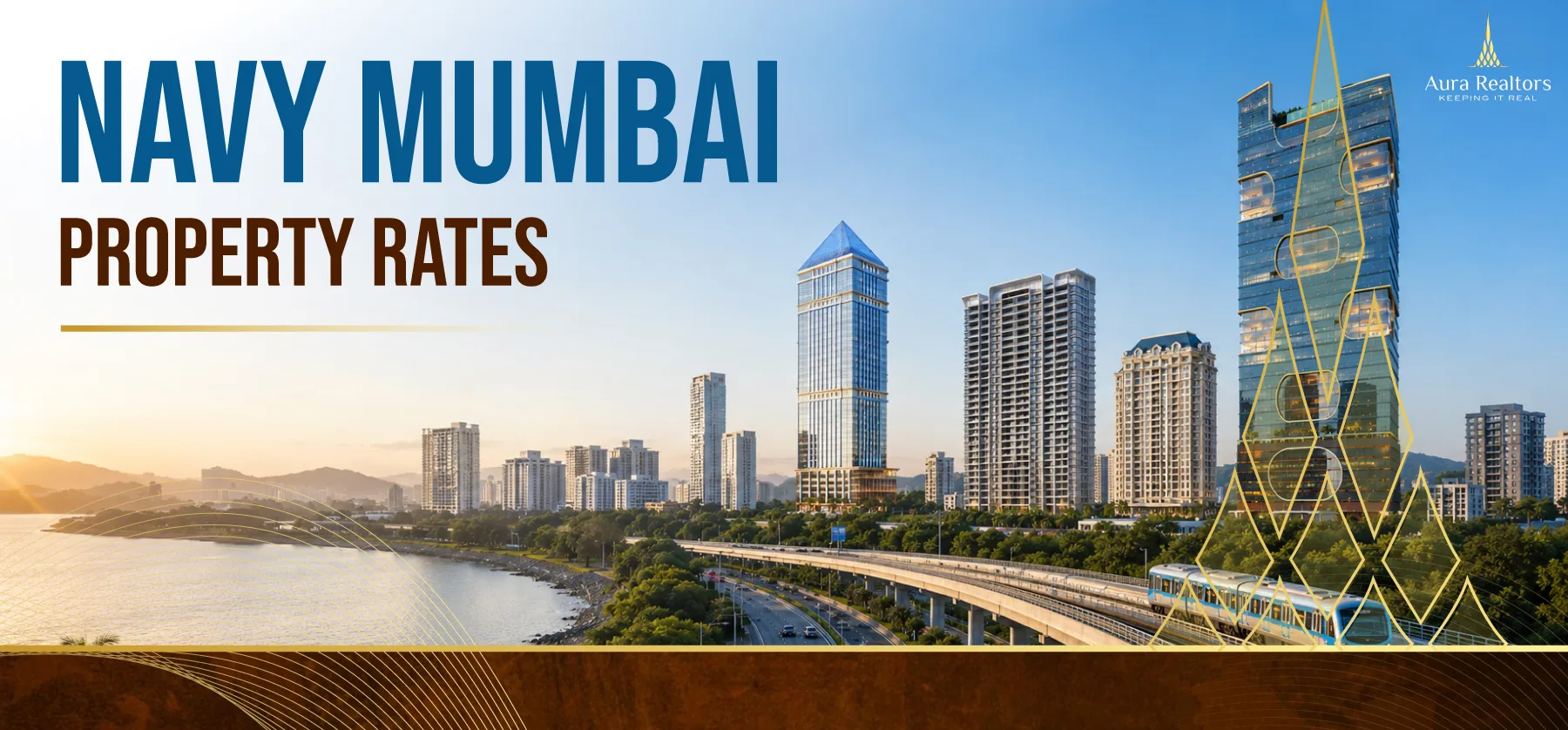

Navi Mumbai Property Price Trends in 2026: Area-Wise Rates, Market Outlook & Investment Guide
Navi Mumbai has entered an important phase of its real estate journey in 2026.
What was once considered an alternative to Mumbai has developed into a major residential, commercial and investment destination within the Mumbai Metropolitan Region. Improved connectivity, large-scale infrastructure development, expanding employment hubs and the growing importance of the Navi Mumbai International Airport are changing how buyers and investors evaluate the region.
As a result, Navi Mumbai property price trends in 2026 are not uniform across every locality. Established locations such as Vashi, Nerul and CBD Belapur command a premium because of mature infrastructure and established social amenities, while areas such as Ulwe, Panvel, Pushpak Nagar and Taloja continue to attract buyers looking for relatively lower entry prices and future growth potential.
Current property portals also demonstrate this variation. For example, Magicbricks' April–June 2026 data lists average flat rates of approximately ₹13,735/sq. ft. in Airoli and ₹16,182/sq. ft. in CBD Belapur, while Housing.com reports approximately ₹11,510/sq. ft. for Kharghar, ₹9,263 for Ulwe, ₹9,008 for Panvel and ₹6,314 for Taloja.
So, are property prices in Navi Mumbai going up in 2026?
The broader trend is positive, but the more important question is: which micro-markets are offering the right combination of price, connectivity, infrastructure, livability and long-term potential?
Let's explore.
Navi Mumbai Property Market in 2026: An Overview
The Navi Mumbai residential market is increasingly being shaped by infrastructure-led demand.
According to Moneycontrol, apartment prices in Navi Mumbai increased by more than 22% between 2021 and 2025, with established premium locations such as Vashi and Seawoods recording particularly strong gains.
The current market is being influenced by several major factors:
- Navi Mumbai International Airport
- Mumbai Trans Harbour Link (Atal Setu)
- Navi Mumbai Metro expansion
- Thane-Belapur Road and highway connectivity
- Growing commercial and IT/ITES activity
- Expansion toward Panvel and the airport corridor
- Increasing demand for premium residential and commercial spaces
However, infrastructure alone does not determine property prices.
Location, project quality, developer credibility, social infrastructure, supply and actual end-user demand remain equally important.
Navi Mumbai Property Rates 2026: Area-Wise Overview
There is no single “Navi Mumbai property price.” Rates differ substantially between micro-markets.
The following figures are useful as indicative 2026 market benchmarks based on currently available property-portal data. Actual transaction prices can vary depending on the project, floor, configuration, age, amenities, carpet area and exact location.
|
Location |
Indicative 2026 Average Rate* |
Market Position |
|
Airoli |
~₹13,735/sq. ft. |
IT & established residential |
|
CBD Belapur |
~₹16,182/sq. ft. |
Premium commercial/residential |
|
Ghansoli |
~₹16,132/sq. ft. |
IT & premium residential |
|
Kharghar |
~₹11,510/sq. ft. |
Established residential |
|
Ulwe |
~₹9,263/sq. ft. |
Airport-led growth |
|
Panvel |
~₹9,008/sq. ft. |
Growth corridor |
|
Taloja |
~₹6,314/sq. ft. |
Value/emerging market |
*Indicative portal data; not a guaranteed transaction price. Sources use different methodologies and property mixes.
This variation is precisely why buyers should compare micro-markets rather than Navi Mumbai as a single property market.
1. Nerul Property Prices in 2026
Nerul continues to occupy an important position among Navi Mumbai's established residential and commercial locations.
The locality benefits from:
- Established residential communities
- Railway connectivity
- Palm Beach Road access
- Proximity to major educational institutions
- Hospitals and healthcare facilities
- Retail and lifestyle infrastructure
- DY Patil Stadium and surrounding developments
- Access to commercial areas
Nerul is particularly interesting for buyers who prioritise existing infrastructure and lifestyle convenience over purely speculative future appreciation.
For investors, commercial developments around the TTC Industrial Area can also provide exposure to Navi Mumbai's expanding business ecosystem.
Aura Realtors' Aura Vertex, located opposite DY Patil Stadium in the TTC Industrial Area, represents this commercial evolution with premium office and commercial spaces.
Who should consider Nerul?
Nerul can be suitable for:
- End-use homebuyers
- Premium residential buyers
- Families seeking established infrastructure
- Commercial investors
- Buyers prioritising connectivity and convenience
2. Kharghar Property Price Trends in 2026
Kharghar remains one of Navi Mumbai's better-known residential destinations.
Its appeal comes from a combination of:
- Planned development
- Metro connectivity
- Educational institutions
- Central Park
- Healthcare facilities
- Residential communities
- Access to major roads
Housing.com's 2026 data places Kharghar's average property rate at approximately ₹11,510 per sq. ft., although individual projects can vary considerably.
Kharghar may appeal particularly to families looking for a balance between livability, infrastructure and long-term property value.
3. Ulwe Property Prices in 2026
Ulwe has become one of the most closely watched property markets in Navi Mumbai.
Its growth story is strongly connected with the airport corridor and broader infrastructure development.
Housing.com's current 2026 data puts the average Ulwe rate at approximately ₹9,263 per sq. ft.
The area attracts:
- First-time buyers
- Young professionals
- Investors
- Buyers looking for relatively lower entry prices
- Airport-oriented investors
However, buyers should not purchase purely because a property is “near the airport.”
Instead, evaluate:
Actual road connectivity + project quality + social infrastructure + possession + developer track record + price per carpet sq. ft.
4. Panvel Property Market in 2026
Panvel is becoming increasingly important in Navi Mumbai's long-term growth story.
The region benefits from its position as a major connectivity point linking:
- Navi Mumbai
- Mumbai
- Pune
- Thane
- The airport corridor
- Emerging residential and commercial zones
Housing.com's 2026 data indicates an average property rate of around ₹9,008 per sq. ft. in Panvel.
The relatively lower entry point compared with some established Navi Mumbai locations makes Panvel attractive to buyers who have a longer investment horizon.
5. Taloja: A Value-Oriented Navi Mumbai Market
Taloja continues to attract buyers looking for comparatively affordable residential opportunities.
Housing.com's 2026 data puts the average rate at approximately ₹6,314 per sq. ft.
This lower entry point can be attractive for:
- First-time buyers
- Budget-conscious families
- Long-term investors
- Buyers looking for larger homes at lower capital values
However, investors should carefully evaluate the specific sector, connectivity, surrounding development and rental demand before buying.
6. Airoli and Ghansoli: IT-Driven Property Markets
Airoli and Ghansoli occupy an important position because of their proximity to employment hubs and the broader Thane-Belapur Road business corridor.
Magicbricks' April–June 2026 data shows an average flat rate of approximately ₹13,735/sq. ft. in Airoli and ₹16,132/sq. ft. in Ghansoli.
These markets benefit from demand generated by:
- IT/ITES companies
- Corporate employees
- Business parks
- Proximity to Thane
- Strong residential demand
- Rental requirements
For investors, employment-led housing demand can be an important consideration because it can support both rental demand and resale liquidity.
What Is Driving Navi Mumbai Property Prices in 2026?
1. Navi Mumbai International Airport
The airport is one of the biggest structural changes affecting the region's real estate narrative.
Its influence extends beyond properties immediately surrounding the airport.
Airport-related growth can generate demand from:
- Aviation employees
- Hospitality businesses
- Logistics companies
- Corporate occupiers
- Retail businesses
- Service providers
- Residential buyers
However, buyers should distinguish between airport proximity as a genuine location advantage and airport proximity used purely as a marketing claim.
2. Mumbai Trans Harbour Link
The Mumbai Trans Harbour Link has improved connectivity between Mumbai and Navi Mumbai.
The resulting reduction in travel friction strengthens Navi Mumbai's appeal to professionals who may previously have preferred locations on the Mumbai side.
This can support demand in established as well as emerging Navi Mumbai markets. Moneycontrol has identified infrastructure, including the airport and metro, as important factors behind the region's property appreciation.
3. Metro Connectivity
Metro expansion is another factor influencing property demand.
For buyers, proximity to mass transit can improve:
- Daily commuting
- Rental demand
- Resale attractiveness
- Commercial footfall
- Long-term location value
But the important point is to look at actual station proximity and operational timelines, rather than relying only on a project's marketing material.
Are Navi Mumbai Property Prices Expected to Increase Further?
The long-term outlook remains positive, but buyers should avoid assuming that every locality will appreciate at the same rate.
A more realistic approach is to divide Navi Mumbai into three broad categories.
Established Markets
Examples:
- Vashi
- Nerul
- Seawoods
- CBD Belapur
- Airoli
These locations generally have stronger existing infrastructure and mature demand.
Growth Markets
Examples:
- Kharghar
- Ghansoli
- Panvel
- Ulwe
These locations combine established infrastructure with significant ongoing development.
Emerging Markets
Examples:
- Pushpak Nagar
- Parts of Dronagiri
- Taloja
- Peripheral Panvel
These can provide lower entry prices but typically require a longer investment horizon and greater location-level due diligence.
Should You Buy Property in Navi Mumbai in 2026?
There isn't a universal yes or no.
The answer depends on your objective.
If you are buying for self-use
Prioritise:
- Commute
- Schools
- Hospitals
- Daily conveniences
- Social infrastructure
- Construction quality
- Carpet-area efficiency
If you are buying for rental income
Focus on:
- Employment hubs
- Tenant demand
- Public transport
- Rental yield
- Vacancy levels
- Property maintenance costs
If you are investing for capital appreciation
Consider:
- Infrastructure pipeline
- Supply-demand balance
- Connectivity
- Developer reputation
- Entry price
- Development potential
- Exit liquidity
7 Things to Check Before Buying Property in Navi Mumbai
1. Compare Carpet-Area Prices
Don't compare properties only on the quoted total price.
Calculate:
Total Property Price ÷ Carpet Area = Effective Price per Sq. Ft.
This gives you a more meaningful comparison.
2. Verify MahaRERA Registration
Before investing in an under-construction project, verify the project's registration, approvals, developer details and project timelines through the official MahaRERA records.
3. Evaluate the Developer
Look at:
- Previous projects
- Delivery history
- Construction quality
- Customer reviews
- Legal history
- Project approvals
- Maintenance standards
- Quality of amenities
- Post-possession support
Visit completed projects by the developer if possible.
Speak to existing residents.
Ask them about:
- Construction quality
- Water supply
- Maintenance
- Security
- Lift operations
- Society management
- Parking
- Overall living experience
This can provide information that isn't available in a sales brochure.
4. Assess Infrastructure Realities
For emerging locations, verify the status of road connectivity, water supply, sewage systems, electrical infrastructure, street lights and basic neighborhood security.
Don't buy properties that assume immediate availability of amenities if development hasn't started.
5. Budget for Additional Costs
Remember to include all non-property acquisition expenses in your total calculation:
- Stamp duty
- Registration
- GST where applicable
- Maintenance deposits
- Parking
- Interiors
- Legal/documentation costs
- Loan processing costs
6. Compare Rental Potential
If your objective is investment, calculate expected rental income against the total acquisition cost.
A property with a lower purchase price isn't necessarily the better investment if tenant demand is weak.
7. Think About Your Exit Strategy
Ask:
Who will buy this property from me five or ten years from now?
A property with strong end-user demand can often provide better exit liquidity than a project dependent entirely on future speculation.
Navi Mumbai Property Price Trends 2026: What Buyers Should Expect
The most important trend in 2026 isn't simply that property prices are rising.
It is that Navi Mumbai is becoming increasingly micro-market driven.
A buyer in Nerul is purchasing a fundamentally different real estate proposition from a buyer in Ulwe.
Similarly, an investor in Rabale's commercial corridor has a different objective from someone purchasing a family apartment in Kharghar.
The infrastructure cycle is creating opportunities, but it also makes property selection more important than ever.
Why Consider Aura Realtors for Your Navi Mumbai Property Search?
Aura Realtors positions itself as a Navi Mumbai-focused real estate company with more than 35 years of combined experience across real estate, construction and infrastructure. Its portfolio includes residential and commercial developments across locations such as Nerul, Rabale and Pushpak Nagar.
Its developments include Aura Vertex in Nerul, Aura One in Rabale, Aura Krishna in Nerul, Aura Pragati in Nerul and Aura Luxuria in Pushpak Nagar.
For buyers, the value of working with a local property advisor is not simply access to listings. It is the ability to compare:
Location → Project → Price → Connectivity → Developer → Rental Potential → Future Demand
That approach can help buyers make a more informed decision rather than choosing a property solely because of a promotional offer or future-infrastructure promise.
FAQ
Property prices vary significantly by locality. Current 2026 portal data shows average rates ranging from roughly ₹6,300/sq. ft. in Taloja to over ₹16,000/sq. ft. in locations such as CBD Belapur and Ghansoli, depending on the dataset and property type.
There is no single best location. Nerul and Vashi may suit buyers prioritising established infrastructure, while Kharghar, Ulwe, Panvel and Pushpak Nagar may appeal to buyers seeking different combinations of affordability and future growth.
Navi Mumbai continues to have strong structural growth drivers, including major connectivity and infrastructure development. However, investors should evaluate individual micro-markets and projects rather than assuming city-wide appreciation.
The airport can strengthen demand and improve the region’s connectivity and economic profile, but appreciation will vary by locality. Airport proximity should be evaluated alongside infrastructure, supply, employment, social amenities and project quality.
Related Articles

Property Buying Checklist in Navi Mumbai: 25 Things to Check
Checklist for Buying Property in Navi Mumbai: 25 Things to Check Before You Buy Buying a property in…
NRI Property Investment in Navi Mumbai: Complete Guide
NRI Property Investment in Navi Mumbai: A Complete Guide for NRIs For Indians living overseas, investing in property…