
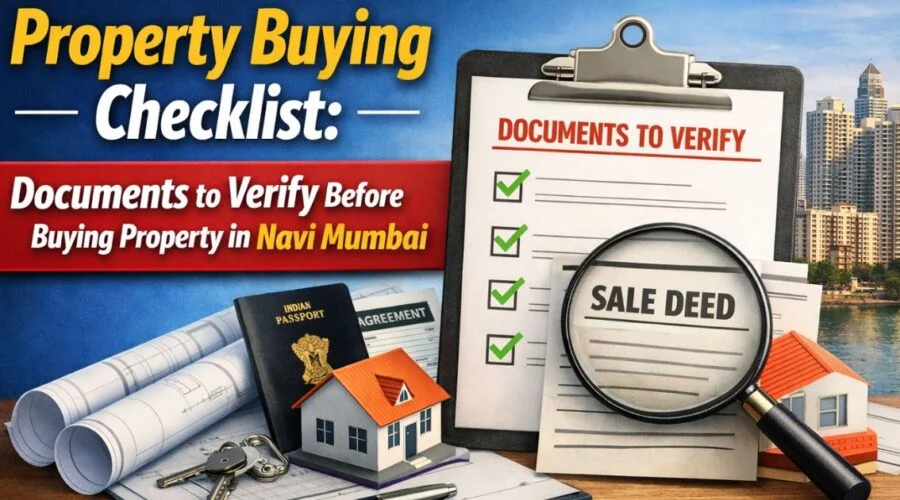
Checklist for Buying Property in Navi Mumbai: 25 Things to Check Before You Buy
Buying a property in Navi Mumbai is a major financial decision. Whether you are purchasing your first home, upgrading to a larger apartment, buying an investment property, or looking for a property near upcoming infrastructure, the right due diligence can help you avoid expensive mistakes.
Navi Mumbai offers a diverse real estate market, with established residential destinations such as Nerul, Seawoods, Vashi, Kharghar and Belapur, as well as emerging locations including Ulwe, Pushpak Nagar and Panvel. Each micro-market has its own combination of connectivity, infrastructure, property prices, lifestyle amenities and investment potential.
That is why choosing the right property requires more than comparing prices.
You need to evaluate the location, developer, legal documents, RERA status, carpet area, total acquisition cost, connectivity, construction quality, amenities and long-term suitability before making a decision.
This comprehensive property buying checklist for Navi Mumbai covers the key things you should check before booking or purchasing a property.
Quick Property Buying Checklist for Navi Mumbai
Before making a final decision, make sure you have checked:
- ☐ Your total property budget
- ☐ Home loan eligibility
- ☐ Down payment requirement
- ☐ Stamp duty and registration costs
- ☐ GST, wherever applicable
- ☐ Carpet area
- ☐ Property location
- ☐ Road and public transport connectivity
- ☐ Nearby schools and hospitals
- ☐ Developer track record
- ☐ MahaRERA registration
- ☐ Project approvals
- ☐ Title and ownership documents
- ☐ Encumbrances or legal disputes
- ☐ Agreement for Sale
- ☐ Possession timeline
- ☐ Construction quality
- ☐ Amenities
- ☐ Maintenance charges
- ☐ Parking
- ☐ Water and power availability
- ☐ Future infrastructure
- ☐ Resale/rental potential
- ☐ Site visits
- ☐ Complete cost comparison
Let's look at each of these in detail.
1. Define Your Property Buying Budget
The first step when buying a flat in Navi Mumbai is understanding how much you can comfortably afford.
Don't calculate your budget only on the basis of your monthly salary or the maximum loan amount a bank is willing to offer.
Consider:
- Monthly household income
- Existing EMIs
- Savings
- Down payment
- Home loan eligibility
- Registration expenses
- Stamp duty
- GST, where applicable
- Interior costs
- Parking charges
- Maintenance deposits
- Emergency fund
- Other family commitments
Calculate the All-In Cost
The advertised property price may not represent the final amount you spend.
Your total acquisition cost can include:
Property Price + Stamp Duty + Registration + GST, where applicable + Parking + Floor-Rise Charges + Legal/Documentation Costs + Maintenance Deposits + Interiors + Other Applicable Charges
Understanding this number before booking helps prevent financial stress later.
2. Decide What Type of Property You Need
Before starting your property search, decide what you actually need.
Are you looking for:
- 1 BHK
- 2 BHK
- 3 BHK
- 4 BHK
- Luxury apartment
- Villa
- Commercial property
- Investment property
For example, a 2 BHK may work well for a young couple or small family, while a 3 BHK may offer greater flexibility for growing families and work-from-home requirements.
The right property isn't necessarily the largest property you can afford.
It should be the one that fits your current lifestyle, future requirements and financial capacity.
3. Choose the Right Location in Navi Mumbai
Location should be one of the most important factors in your property buying decision.
Some of the major residential markets buyers may consider include:
- Nerul
- Seawoods
- Vashi
- Kharghar
- CBD Belapur
- Airoli
- Ghansoli
- Kopar Khairane
- Ulwe
- Pushpak Nagar
- Panvel
The best location depends on your objective.
For self-use
Prioritise:
- Workplace connectivity
- Schools
- Hospitals
- Daily shopping
- Public transport
- Lifestyle amenities
- Neighbourhood quality
For rental investment
Look at:
- Employment hubs
- Tenant demand
- Public transport
- Rental values
- Vacancy levels
For long-term investment
Evaluate:
- Infrastructure development
- Connectivity
- Entry price
- Supply and demand
- Development potential
- Resale liquidity
Aura Realtors' existing Navi Mumbai buyer guide similarly recommends evaluating location based on workplace, transport, schools, hospitals and neighbourhood conditions rather than choosing a locality purely because it is popular.
4. Check Connectivity
Before buying property in Navi Mumbai, don't simply accept the statement that a project is "well connected."
Check the actual travel time.
Evaluate accessibility to:
- Railway stations
- Navi Mumbai Metro
- Major roads
- Highways
- Business districts
- Schools
- Hospitals
- Shopping destinations
- Airports
- Mumbai
Pro Tip
Visit the property during morning and evening peak hours.
A location that takes 15 minutes to reach at 11 AM could take considerably longer during peak traffic.
5. Research Property Prices in Navi Mumbai
Before booking a property, research the prevailing property prices in Navi Mumbai and compare similar properties.
Compare:
- Price per sq. ft.
- Carpet area
- Total price
- Configuration
- Floor
- Age of property
- Amenities
- Parking
- Location
- Developer
- Possession status
Don't compare two properties only on their headline price.
A ₹2 crore apartment in one micro-market may offer very different value compared with a ₹2 crore property elsewhere.
6. Always Compare Carpet Area
One of the most important things to check before buying a flat in Navi Mumbai is the actual carpet area.
Property advertisements may mention:
- Carpet area
- Built-up area
- Super built-up area
For meaningful comparisons, understand exactly what area is being quoted.
For example:
Property A: ₹18,000 per sq. ft. on carpet area
Property B: ₹15,000 per sq. ft. on another area basis
Property B isn't necessarily cheaper.
Always compare properties on a like-for-like carpet-area basis.
7. Verify MahaRERA Registration
For eligible new projects, checking MahaRERA registration should be an essential part of your property buying checklist.
Verify:
- RERA registration number
- Promoter details
- Project details
- Approved plans
- Construction status
- Possession timeline
- Project disclosures
- Relevant complaints/orders, where available
Aura Realtors' existing RERA guide also recommends independently checking project information rather than relying solely on documents or screenshots provided during the sales process.
Important: RERA verification is an important due-diligence step, but it should not replace independent legal advice.
8. Check the Developer's Track Record
Before buying a new property, research the developer.
Look at:
- Completed projects
- Delivery history
- Construction quality
- Customer reviews
- Legal track record
- Project approvals
- Quality of amenities
- Maintenance standards
- Post-possession support
If possible, visit one of the developer's completed projects.
Speak to existing residents.
Ask them about:
- Construction quality
- Water supply
- Maintenance
- Lift operations
- Security
- Parking
- Society management
- Overall living experience
This can provide valuable information beyond the sales brochure.
9. Verify the Property's Legal Documents
Legal due diligence is one of the most important steps when purchasing property in Navi Mumbai.
Depending on the type of property and transaction, relevant documents may include:
- Title documents
- Ownership records
- Development rights
- Approved plans
- Building permissions
- RERA registration
- Encumbrance-related records
- Agreement for Sale
- Occupancy Certificate, where applicable
- Property tax records
- Society documentation for resale properties
A qualified property lawyer should review the relevant documents before you commit to the purchase.
Never Skip Legal Verification
The cost of professional legal advice is small compared with the potential financial consequences of unresolved legal issues.
10. Understand the Agreement for Sale
Don't sign the Agreement for Sale without understanding its terms.
Pay attention to:
- Total consideration
- Payment schedule
- Possession date
- Cancellation terms
- Default clauses
- Interest provisions
- Maintenance obligations
- Parking
- Amenities
- Specifications
- Carpet area
- Other charges
If you don't understand a clause, ask a qualified professional before signing.
11. Check the Possession Timeline
If you're buying an under-construction property, carefully evaluate the expected possession timeline.
Consider:
- Current construction stage
- RERA completion date
- Construction progress
- Developer's previous delivery record
- Project approvals
- Infrastructure around the project
Don't make financial plans based only on an informal possession promise.
The RERA project information and Agreement for Sale should be reviewed carefully.
12. Ready Possession vs Under-Construction Property
Another important decision is whether to buy a ready possession flat in Navi Mumbai or an under-construction property.
Ready Possession
Advantages:
- You can inspect the actual apartment.
- You can assess the building.
- You can see the surrounding neighbourhood.
- Possession may be available sooner.
- Existing amenities can be evaluated.
Under Construction
Advantages may include:
- More choice of units
- Newer amenities
- Earlier entry into the project lifecycle
- Potentially different payment structures
However, buyers should carefully evaluate construction progress, developer track record, RERA details and possession timelines.
Aura Realtors has a dedicated guide comparing these two options in greater detail.
13. Inspect the Apartment Layout
Two apartments with the same carpet area can feel completely different because of their layout.
Check:
- Living room size
- Bedroom dimensions
- Kitchen layout
- Balcony
- Storage
- Natural light
- Ventilation
- Passage area
- Bathroom placement
- Window orientation
- Privacy
Don't evaluate a home solely by its square-footage figure.
Look at how effectively the space is actually used.
14. Check Construction Quality
If you're buying a ready property, inspect the apartment carefully.
Look for:
- Wall cracks
- Dampness
- Water leakage
- Flooring
- Doors and windows
- Plumbing
- Electrical fittings
- Bathroom quality
- Kitchen fittings
- Ceiling condition
- Common-area maintenance
For an under-construction property, review the developer's construction specifications and completed projects.
15. Evaluate Amenities Carefully
Amenities can make a project attractive, but they shouldn't be the primary reason you purchase a property.
Look beyond:
- Swimming pool
- Gym
- Clubhouse
- Children's play area
- Garden
Also evaluate:
- Quality
- Maintenance
- Usability
- Open spaces
- Security
- Parking
- Community areas
The basic fundamentals should come first:
Location → Connectivity → Developer → Legal Status → Construction Quality → Price → Layout → Amenities
16. Check Parking Availability
Parking can become an important issue after possession.
Before buying, understand:
- Whether parking is included
- Type of parking
- Number of parking spaces
- Visitor parking
- Parking charges
- EV charging availability, where relevant
Make sure the parking arrangement is clearly documented.
17. Calculate Home Loan Eligibility
If you are financing your purchase through a home loan, check your eligibility before finalising the property.
Compare:
- Interest rates
- Loan tenure
- Processing fees
- Prepayment conditions
- EMI
- Total interest payable
Don't borrow the maximum amount simply because you are eligible for it.
Your EMI should remain manageable alongside your other financial commitments.
18. Budget for Stamp Duty, Registration & Other Costs
The property price is only one part of the purchase.
Your financial planning should account for applicable:
- Stamp duty
- Registration charges
- GST, where applicable
- Legal fees
- Brokerage
- Parking
- Maintenance deposits
- Interior costs
- Moving expenses
- Other project-specific charges
Always ask for a complete cost sheet before making your final decision.
19. Visit the Property More Than Once
Never make your final property decision based on a single site visit.
Visit:
Morning → Evening → Weekend
Check:
- Traffic
- Noise
- Parking
- Neighbourhood
- Construction activity
- Public transport
- Local shops
- Road conditions
- Surrounding buildings
If possible, visit the actual apartment instead of relying only on a sample flat.
20. Check Schools, Hospitals & Daily Convenience
For families, social infrastructure can significantly influence the quality of life.
Check proximity to:
- Schools
- Colleges
- Hospitals
- Pharmacies
- Supermarkets
- Restaurants
- Banks
- Fitness centres
- Parks
- Public transport
A property may be attractive today, but daily convenience matters for the years you plan to live there.
21. Evaluate Future Infrastructure
Infrastructure can influence the long-term attractiveness of a location.
Navi Mumbai is undergoing significant infrastructure development, including major connectivity projects and growth around emerging corridors.
However, don't assume that every infrastructure announcement automatically means property prices will increase.
Evaluate:
- Actual project status
- Distance from the property
- Expected completion
- Connectivity benefits
- Existing demand
- Supply of competing properties
The impact of infrastructure is usually location-specific. Aura Realtors' analysis of Atal Setu, for example, notes that established markets such as Nerul, Seawoods and CBD Belapur have a different proposition from emerging areas such as Ulwe, Pushpak Nagar and Panvel.
22. Consider Rental & Resale Potential
Even if you're buying a home for self-use, it's worth considering future resale and rental demand.
Ask:
- Who would rent this property?
- Who would buy it from me later?
- Is there strong employment nearby?
- Is public transport accessible?
- Is the location established?
- How much competing inventory exists?
- What are comparable rents?
- How liquid is the local property market?
This doesn't guarantee appreciation or rental returns, but it helps you understand the property's broader market appeal.
23. Compare at Least Three Properties
Don't make your decision after seeing only one project.
Shortlist at least three properties and compare them using the same parameters.
|
Factor |
Property A |
Property B |
Property C |
|
Location |
|
|
|
|
Carpet Area |
|
|
|
|
Total Price |
|
|
|
|
Price/sq. ft. |
|
|
|
|
Developer |
|
|
|
|
RERA Status |
|
|
|
|
Possession |
|
|
|
|
Connectivity |
|
|
|
|
Amenities |
|
|
|
|
Parking |
|
|
|
|
Maintenance |
|
|
|
|
Resale Potential |
|
|
|
This turns an emotional purchase decision into a more objective comparison.
24. Don't Rush Because of Sales Pressure
You may hear:
- "Only two units are left."
- "The price increases tomorrow."
- "Book today."
- "This offer ends tonight."
Genuine inventory and pricing changes can happen, but they shouldn't replace due diligence.
Before paying a booking amount, make sure you understand:
- Total price
- Payment schedule
- Cancellation terms
- Refund provisions
- Agreement terms
- Additional charges
- Possession timeline
- Applicable government charges
A property purchase should be based on financial readiness and due diligence, not pressure.
25. Take Independent Professional Advice
Buying a property involves legal, financial and technical considerations.
Depending on your situation, consider consulting:
- Property lawyer
- Financial advisor
- Home loan advisor
- Chartered accountant, where relevant
- Property valuation professional
Independent advice can help identify issues that may not be obvious during the sales process.
Common Mistakes to Avoid When Buying Property in Navi Mumbai
1. Buying only because the property is cheap
Lower price doesn't necessarily mean better value.
2. Ignoring the location
A cheaper home with a difficult commute may not be the better choice.
3. Skipping legal verification
Never compromise on legal due diligence.
4. Comparing only price per sq. ft.
Always understand the area basis and total acquisition cost.
5. Ignoring additional charges
Stamp duty, registration, GST where applicable, parking and interiors can significantly affect the total cost.
6. Not researching the developer
Look beyond the brochure.
7. Buying solely for expected appreciation
Future appreciation is never guaranteed.
8. Not visiting the location at different times
The neighbourhood can feel very different during peak hours.
9. Choosing amenities over fundamentals
A clubhouse cannot compensate for poor location, construction quality or legal issues.
Final Property Buying Checklist
Before you make the final payment or sign the agreement, ask yourself:
Financial
☐ Can I comfortably afford the property?
☐ Have I calculated the complete acquisition cost?
☐ Is the EMI manageable?
☐ Have I budgeted for interiors and recurring expenses?
Property
☐ Have I checked the carpet area?
☐ Have I inspected the layout?
☐ Have I checked construction quality?
☐ Is parking adequate?
Legal
☐ Have I verified MahaRERA details?
☐ Has a lawyer reviewed the relevant documents?
☐ Have I understood the Agreement for Sale?
☐ Have I checked applicable approvals and possession documentation?
Location
☐ Is the property well connected?
☐ Are schools and hospitals accessible?
☐ Is public transport convenient?
☐ Have I visited during peak hours?
Investment
☐ Is there genuine rental demand?
☐ Is the location likely to remain attractive?
☐ Have I compared competing properties?
☐ Is there a reasonable resale market?
If you can confidently answer these questions, you're much better prepared to make an informed property decision.
Should You Buy Property in Navi Mumbai?
Navi Mumbai offers buyers a wide range of residential opportunities, from established locations such as Nerul and Seawoods to emerging markets such as Ulwe, Pushpak Nagar and Panvel.
But there is no single "best property in Navi Mumbai" for every buyer.
The right property depends on your:
- Budget
- Family requirements
- Workplace
- Preferred configuration
- Lifestyle
- Investment objective
- Risk appetite
- Long-term plans
The most important thing is to evaluate the complete property-buying equation rather than focusing on just one factor such as price or location.
Why Choose Aura Realtors for Your Navi Mumbai Property Search?
Finding the right property becomes easier when you have access to local market knowledge and a structured buying process.
Aura Realtors brings 35+ years of combined experience across real estate, construction and infrastructure, with a focus on residential and commercial developments across Navi Mumbai and Panvel. Its portfolio covers options ranging from affordable homes to luxury residences and commercial spaces.
Whether you're looking for:
- Flats for sale in Navi Mumbai
- A first home
- A 1 BHK or 2 BHK
- A larger family apartment
- A luxury residence
- A ready-possession property
- An under-construction project
- A property for investment
- Commercial real estate
the objective should be to find a property that fits your budget, lifestyle and long-term goals.
Looking for Property in Navi Mumbai?
Explore Aura Realtors' residential and commercial property options or speak with the team to identify properties that match your requirements.
FAQ
Check your budget, carpet area, location, connectivity, developer track record, MahaRERA registration, legal documents, possession timeline, construction quality, amenities, parking, maintenance costs and the complete acquisition cost.
Depending on the property, relevant documents can include title and ownership documents, approvals, RERA details, Agreement for Sale, occupancy documentation where applicable, property tax records and other project or society documents. Independent legal verification is recommended.
Search for the project on the official Maharashtra RERA platform and verify the registration details, promoter, project status, completion timeline and available disclosures. Don’t rely solely on information provided by a salesperson.
Navi Mumbai offers a diverse property market with established residential locations, emerging growth corridors, employment hubs and major infrastructure development. Whether it is right for you depends on your budget, objective, preferred location and long-term requirements.
Related Articles

NRI Property Investment in Navi Mumbai: Complete Guide
NRI Property Investment in Navi Mumbai: A Complete Guide for NRIs For Indians living overseas, investing in property…
Ready Possession vs Under-Construction Flats in Navi Mumbai: Which IsBetter in 2026?
Ready Possession vs Under-Construction Flats in Navi Mumbai: Which Is Better in 2026? Buying a home is one…